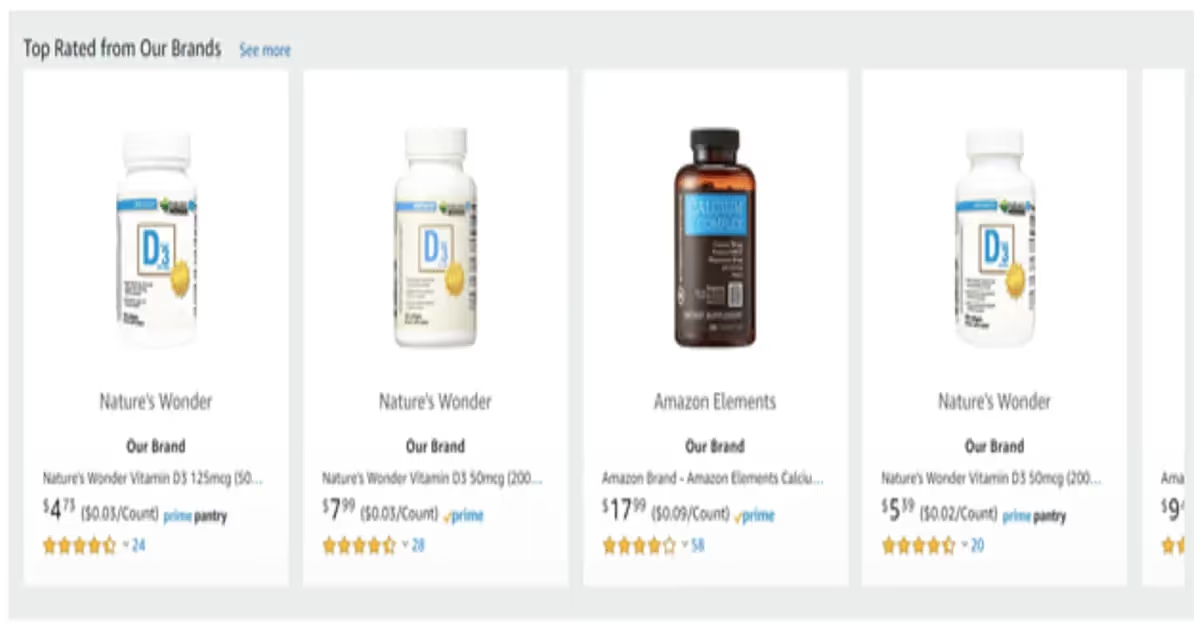
When Amazon's Own Brand Shows Up in Your Category
It's a uniquely unsettling moment: you've built a product to a solid rank, and then a house-brand version appears in the same search results — similar enough to compete, usually cheaper, and carrying advantages no third-party seller can replicate. It's tempting to either panic or pretend it isn't happening. Neither helps. The reality is you can't beat a marketplace's own brand at being the marketplace's own brand, so the entire game is figuring out where those brands are structurally weak and competing hard there. Most house lines have very specific blind spots, and that's your opening.
Be honest about what you can't win
Start by accepting the fights you'll lose, so you don't waste energy on them. A platform's own brand can lean on house placement, often prices aggressively because it has cost and data advantages you don't, and rarely worries about being undercut by the platform itself. If your only plan is to be cheaper, you're walking into the one contest it's built to win — and you'll shred your margin trying. The goal isn't to match it on price or placement. It's to make those things matter less to the shopper by competing on dimensions the house brand treats as an afterthought.
Compete where the house brand is generic
Private-label lines are usually built to be broadly acceptable to the largest possible audience, which makes them generic by design. That generality is exactly what you exploit. The openings tend to cluster in a few places:
- The specific use case the generic product serves adequately but not well — the buyer with a particular need who wants a product built for them, not for everyone.
- Quality and materials a shopper can see and feel, where a visibly better product justifies a higher price instead of apologizing for it.
- The brand story and trust that a faceless house label simply doesn't have, which matters more in categories where buyers care who made the thing.
- Bundles, sizes, and configurations the house brand doesn't bother to offer because they don't fit a mass-market SKU.
- Service and responsiveness — answering questions, standing behind the product, and earning reviews that read like a real brand cares.
You're not trying to be the default cheap option. You're trying to be the obviously-better choice for a shopper who has a reason to look past the cheapest result — and there are more of those shoppers than the race-to-the-bottom crowd assumes.
Don't fight a margin war you'll lose
The most expensive mistake is reflexively dropping your price to chase a house brand down, because you'll bleed margin while it barely feels the pressure. Before you touch your price, you need to know what's actually left after the marketplace's referral fee of roughly 15%, fulfillment, your cost of goods, and ad spend — because a price cut that wins the click can quietly turn a profitable product into a break-even one. Sometimes the right move is the opposite: hold or raise your price, lean into the better-product positioning, and let the house brand have the bargain-hunter while you keep the buyer who'll pay for quality. You can only make that call confidently if you can see your real net margin at each price point instead of guessing.
Watch the threat without obsessing over it
A house brand entering your category is information, not a death sentence — but you do want to track what it's actually doing. Is it holding the buy box through price, or is your product still winning meaningful share? Is it pulling demand away, or coexisting because you serve a different slice of the market? Keeping an eye on the competitive picture — who's winning the sale, at what price, with what fulfillment — tells you whether the house brand is a real threat to your specific positioning or just noise in the same search results. The answer determines whether you need to adapt hard or simply keep doing what already works for your buyer.
Build something a marketplace wouldn't bother to copy
The durable defense against any house brand is to occupy ground that's not worth a mass-market line's effort to take. Generic platforms chase big, obvious, high-volume opportunities; they're far less interested in the specific, the premium, the community-driven, and the genuinely differentiated. If your product is just a slightly cheaper version of the obvious thing, you're squarely in the crosshairs. If it's the considered choice for a particular buyer who trusts your brand, you're playing a game the house label isn't really set up to win. Build toward the second one, and a house brand showing up becomes a manageable competitor instead of an existential threat.
Know your real margin before you react to a new competitor.
See how it worksFrequently asked questions
Should I just lower my price when a house brand undercuts me?
Usually not as a reflex. A house brand often has cost and data advantages that let it win a price war you can't, so matching it down the ladder mostly just destroys your margin. Check what's actually left after fees, cost of goods, and ad spend at the lower price first — and consider holding or raising your price while competing on quality and trust instead, keeping the buyer who'll pay for the better product.
How do I tell if the house brand is really hurting me?
Track who's winning the sale in your category and at what price. If you're still holding meaningful buy-box share and your demand is steady, the house brand may simply be serving a different slice of the market than you do. If it's clearly pulling your sales and holding placement through price, that's the signal to lean harder into differentiation rather than try to match it head-on.
Is it even worth competing in a category an Amazon brand has entered?
Often yes — as long as you're not just a cheaper version of the same generic thing. House brands are built for the broad middle of a market and tend to ignore specific use cases, premium quality, and real brand trust. If you can own one of those, there's room to be the better choice for a meaningful set of buyers even with a house label sitting right beside you.