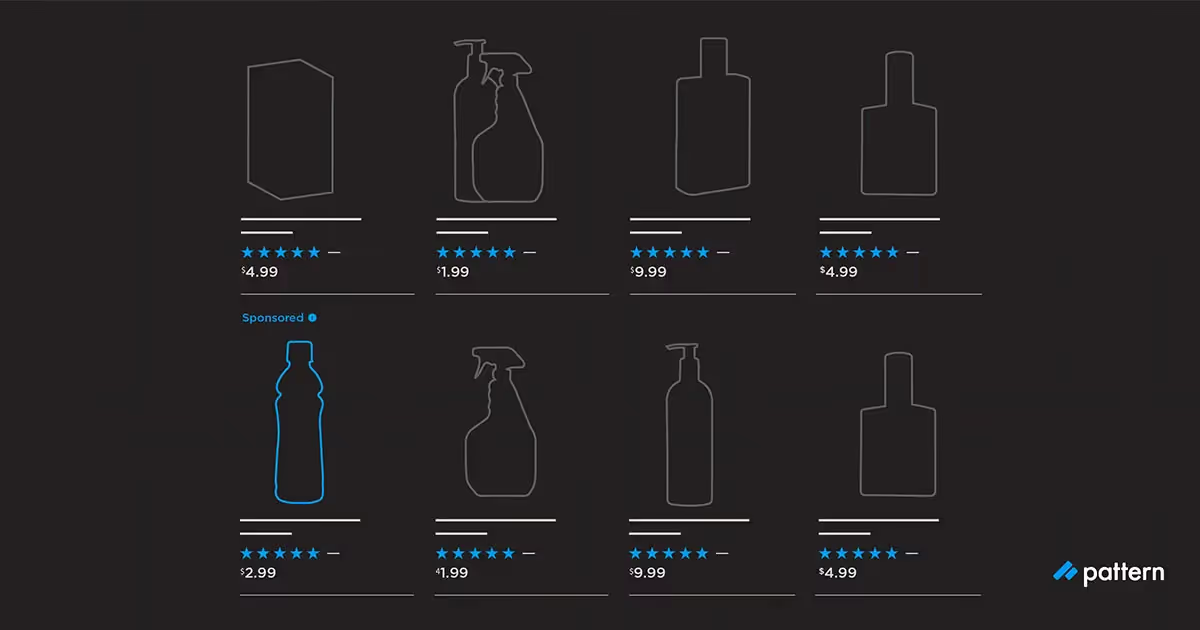
Is Your Product Ready to Advertise on Amazon? A Pre-Flight Checklist
Advertising doesn't fix a weak listing — it exposes it faster and charges you for the privilege. Ads are an amplifier: whatever your detail page does well or badly, it now does at scale and at a cost per click. Point ads at a product that converts and you accelerate a good thing; point them at one that can't close the sale and you're paying to broadcast its weaknesses. Conversion is the part advertising can't buy for you. So the real question before a campaign isn't 'how should I bid' — it's 'can this listing convert the traffic I'm about to pay for?' If a product fails the basics below, money spent fixing the listing returns far more than the same money on ads.
The conversion fundamentals have to be in place
A shopper who clicks your ad lands on the same detail page as everyone else, and that page has a few seconds to earn the sale. The non-negotiables:
- A strong main image — clean, sharp, well-lit, on a white background. It's the single biggest driver of whether a shopper clicks through and stays.
- A clear, benefit-led title — it should say exactly what the product is and why it matters, not read like a keyword pileup.
- Bullets that answer objections — handle the obvious questions before the shopper has to go looking.
- Enough images to remove doubt — multiple angles and the product in use, closing the gap between 'interested' and 'confident'.
- A competitive price — if you're meaningfully above comparable products without a reason, ads just buy clicks that bounce to a cheaper option.
If any of these is clearly weak, fix it before you advertise. The return on improving a poor main image or a confusing title is almost always higher than ad spend pointed at the unfixed version — because every future click, paid and organic, converts better once the page does its job.
Reviews and rating: the trust threshold
Social proof is part of conversion, and shoppers use it as a shortcut for trust. A product with zero reviews or a low star rating converts worse, so your ads cost more per sale until that's addressed. The distinction that matters is intent. Advertising a *new* product to build the early reviews it doesn't have yet is a strategy — expect poor early efficiency. But pouring spend into an *established* product sitting at a poor rating amplifies a trust problem, and the smarter move is to fix the rating first, because no ad budget out-converts a one-star average.
The economics have to support the spend
A listing can be beautifully optimized and still be a bad candidate for advertising, because ad cost has to come out of a margin that can absorb it. A thin-margin product needs a very efficient campaign just to break even, leaving little room for experimentation. Work out the true profit per unit — selling price minus the referral fee, fulfillment, and landed cost — before you commit. If the margin is so thin any realistic campaign loses money, the answer isn't a cleverer bidding strategy — it's a different product, a higher price, or a lower cost. Advertising can't manufacture margin that isn't there.
A quick go / no-go test
Before funding a campaign, run the product through a fast gut check. It's ready to advertise when the basics line up:
- The main image and title make the value obvious at a glance.
- The listing is complete — strong images, objection-handling bullets, a competitive price.
- Social proof is adequate for the goal — or you're knowingly advertising a new product to build it.
- The unit economics support it — there's enough margin per sale to fund ad spend and still profit.
- You can measure the result — you'll watch conversion and true profitability, not just clicks, to judge whether it's working.
Fail several of these and the highest-return move is to fix the listing or rethink the product, not launch a campaign. Advertising is the accelerator you press once the car is built — not the thing that builds it.
Check whether a product has the margin to advertise profitably.
See the profit toolsFrequently asked questions
Can I advertise a brand-new product with no reviews?
Yes — that's a launch, legitimate as long as you go in with the right expectations. Advertising a new product is partly how you generate its first sales and reviews, so expect a higher cost per sale early and treat it as buying ranking and review velocity, not immediate profit. What you shouldn't do is point heavy spend at an *established* product with a poor rating; that's amplifying a trust problem, a different situation entirely.
My listing converts well — do I still need to check the margin?
Absolutely. Conversion and profitability are separate tests, and a product can ace one while failing the other. A page can convert beautifully and still be a poor advertising candidate if the margin per unit is too thin to absorb ad cost — you'd be efficiently selling at a loss. Always confirm the unit economics support ad spend, not just that the listing closes the sale.
What's the single most common reason ads underperform?
A listing that can't convert the traffic. Sellers blame bids, keywords, or budget when the real culprit is upstream — a weak main image, a confusing title, thin reviews, or an uncompetitive price quietly killing the conversion rate. Advertising sends traffic; the listing has to close it. Fix the page first and the same ad spend almost always performs better.