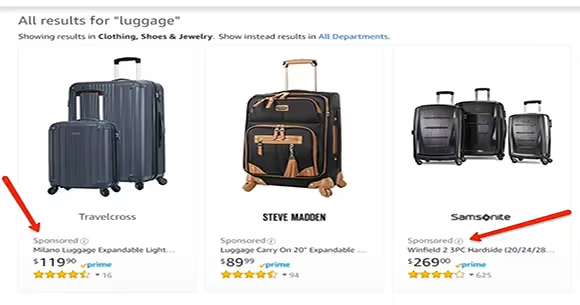
Sponsored Display: The Underused Lever for Defending and Conquesting
Sponsored Products is where almost everyone starts and where most ad budgets stay. But there's a second lever that sits right next to it — Sponsored Display — and it does things keyword-driven search ads simply can't: place your product *on a competitor's detail page*, follow shoppers who viewed but didn't buy, and wall off your own listings from poachers. Used deliberately, it's one of the highest-leverage tools in your account. Used as a 'set it and forget it' box you ticked, it's a slow budget leak.
What Sponsored Display actually does differently
Where Sponsored Products bids on *search terms*, Sponsored Display targets *products and audiences*. That unlocks placements and intent stages you can't reach through search alone:
- Product targeting — your ad appears on specific competitor detail pages and in related-product placements, so you intercept shoppers while they're evaluating an alternative.
- Audience re-engagement — you reach shoppers who viewed your product (or similar ones) and left, nudging them back during the consideration window.
- Category and interest targeting — broader reach across shoppers browsing your category, useful for awareness on newer products.
- Off-search and off-Amazon placements — display inventory extends beyond the search results page, putting your product in front of people who aren't actively searching yet.
Play offense: land on competitor pages
The most direct win is product targeting against competitors. When a shopper is on a rival's detail page, they've already signaled they want something in your category — they just haven't committed to a seller. Placing your ad there, ideally with a better price, stronger reviews, or a clearer value proposition, is among the highest-intent interceptions available anywhere in the ad ecosystem.
Be selective. Target competitors you can genuinely beat on price, rating, or review count — putting your ad on the page of a cheaper, better-reviewed rival mostly buys clicks that bounce straight back. The point is to win the comparison, not just to show up for it.
Play defense: protect your own detail pages
Here's the flip side — competitors are running this exact play against *you*. They're targeting your detail pages to peel off your highest-intent traffic at the moment of decision. Running Sponsored Display on your own and complementary listings keeps that real estate occupied with your products instead of leaving an open lane for a rival to convert the shopper you already attracted.
Re-engage the shoppers who got away
Most shoppers don't buy on the first visit. Audience re-engagement lets you stay in front of people who viewed your product and bounced — recovering sales from demand you already paid to generate. It tends to be efficient because you're talking to warm shoppers, but it can also turn wasteful if you let it run unbounded, so cap the spend and watch what it actually returns.
Measure it differently than Sponsored Products
Display behaves differently from search, and judging it by the same yardstick will lead you astray:
- Expect a different ACoS profile. Upper-funnel and awareness placements convert on a longer arc than bottom-funnel search clicks; raw ACoS can read higher even when the campaign is doing its job.
- Account for the halo. Display drives detail-page views and brand discovery that show up later — sometimes as organic sales or a Sponsored Products conversion days afterward.
- Always check it against real margin. A campaign defending a hero product can be worth running even at a higher ACoS, *if* the product's margin can carry it. A loose, broad audience campaign at the same ACoS may just be a leak. The number alone doesn't tell you which — your unit economics do.
Find the competitor listings you can win — and the products that can fund the fight.
Try UPC MetricsFrequently asked questions
Is Sponsored Display worth it for a small catalog?
Yes, especially for defense. Even a couple of hero products benefit from keeping their own detail pages occupied with your ads rather than a competitor's. Start narrow — defend your bestsellers and re-engage past viewers — before expanding into broad category targeting.
Why is my Sponsored Display ACoS higher than Sponsored Products?
Because much of Display is upper-funnel — awareness and consideration placements that convert over a longer window than a bottom-of-funnel search click. Judge it on incremental and halo impact and against your product's margin, not against your search ACoS.
Should I target every competitor I can find?
No. Target competitors you can beat on price, rating, or reviews. Putting your ad on the page of a cheaper, higher-rated product mostly generates clicks that bounce. Win the comparison — don't just appear in it.