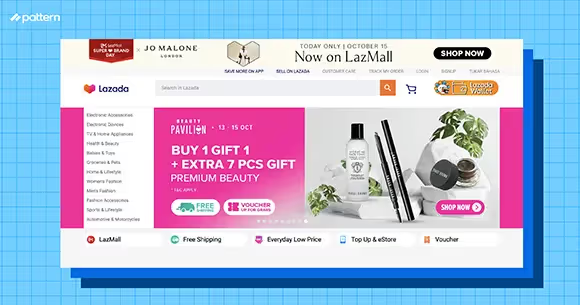
Selling on Lazada: What Marketplace Sellers Should Weigh Before Entering Southeast Asia
Southeast Asia is one of the fastest-growing ecommerce regions in the world, and Lazada is one of its anchor marketplaces, operating across several countries in the region. For a seller who's saturated their home market, that growth is tempting. But Southeast Asia is not one market — it's a cluster of distinct countries with different languages, currencies, payment habits, and logistics realities. Lazada gives you a single platform to reach them, but it doesn't erase those differences. Before you ship a single unit, it's worth understanding what makes this region genuinely different from selling at home.
It's a region, not a country
The first mental shift is that 'selling on Lazada' actually means selling into multiple national markets, each with its own buyer base. What sells in one country may be flat in another; pricing that works in a wealthier market may be out of reach in a more price-sensitive one. You don't have to enter every market at once — and you shouldn't. Pick one country to start, learn its buyer, and expand from a position of knowledge rather than spreading thin across the whole region on day one. Treating the region as monolithic is the fastest way to misprice and misjudge demand.
Logistics and cross-border fulfillment
Lazada typically offers cross-border programs that let you sell into the region without immediately setting up local operations in every country — you ship into the program's network and it handles last-mile delivery to customers. That lowers the barrier to entry, but it comes with trade-offs: longer delivery times for cross-border orders, which affects how shoppers perceive you, and the import duties and clearance that come with moving goods across borders. As your volume in a given market grows, holding stock locally usually improves delivery speed and cost. Map out which model you're using and what it does to both your delivery promise and your landed cost before you set prices.
Payments and buyer behavior are different
Don't assume your home market's payment norms travel. Several Southeast Asian markets have historically had high rates of cash-on-delivery and a strong mobile-first shopping culture, with buyers discovering and purchasing largely on their phones. Cash-on-delivery in particular changes your risk profile — refused or returned COD orders are a cost you may not be used to. Mobile-first shopping means your listing images and content have to work hard on a small screen. And the region is intensely promotion-driven, with major shopping festivals that concentrate demand. Understanding how local shoppers actually buy is as important as the logistics of getting goods to them.
What to weigh before you commit
- Margin after cross-border costs. Duties, longer shipping, currency conversion, and platform fees all stack on top of your landed cost — model the full picture per market before pricing.
- Localization effort. Listings, customer service, and promotions often need adapting per country; budget the time and cost.
- Competition and price sensitivity. Some categories are fiercely price-competitive in the region; check whether your product can win on something other than being cheapest.
- Returns and COD risk. Understand the local norms and what they do to your effective margin.
- Operational bandwidth. A new region is a real commitment — don't enter unless you can support it without starving your core business.
Start small and let the data decide
The smartest way into any new region is a controlled test, not a full-scale launch. Pick one country and a focused set of SKUs you believe fit local demand, use a cross-border model to limit your upfront commitment, and watch the real numbers — net margin after all the region-specific costs, return and COD behavior, and how delivery times affect your conversion. If a market proves itself, you scale into it and consider local fulfillment. If it doesn't, you've risked a test budget, not your business. Let proven profit, not the size of the regional opportunity, decide where you double down.
Keep your margin discipline as you expand into new markets.
See the profit toolsFrequently asked questions
Do I need a local entity to sell on Lazada?
Often no, at least to start — cross-border seller programs are designed to let you reach the region without setting up a local company in each country, shipping into the platform's network instead. Requirements vary by market and change over time, so confirm the current setup for the specific country you're targeting. As your volume grows, a local presence or local fulfillment can improve delivery speed and cost, but it's rarely required for an initial test.
How is selling in Southeast Asia different from my home market?
Three things stand out: it's a cluster of distinct national markets rather than one, so demand and pricing vary widely; buyer behavior skews heavily mobile-first and, in several markets, toward cash-on-delivery, which changes your risk and return profile; and the region is intensely promotion- and festival-driven. The product economics also shift once you layer in duties, currency conversion, and longer cross-border shipping. Plan per country, not for the region as a whole.